MARILYN MAYE ONLINE

Archive for the ‘Inspiring books & videos’ Category

Two must-reads for 2011 summer – one short, one long

In Inspiring books & videos on June 11, 2011 at 10:47 pm

2011 is one hundred years after the time that many of our ancestors first came to places like New York City, where I was born.  Some came from overseas, others came from the southern United States.  They didn’t think of themselves as pioneers in a historic movement of peoples who would re-shape the urban centers for decades to come.  But, that’s exactly what they did. 

One of two books that capture this historic movement is Isabel Wilkerson’s  The Warmth of Other Suns, a phenomenal, destined-to-become-classic of Grapes of Wrath proportions.  It’s a must-read for every African-American, and black or wihte immigrant from anywhere. 

There are many stereotypes about the hard-working, closely-knit-to-family, education-focused immigrant families; but, these images are rarely tied to people of the Black migrations from the U.S. South.  When migrants left the Jim Crow South, de facto segregation in the North and West  meant that they were restricted to living indistinguishably among other blacks who had been in those places a lot longer.  They were stereotyped by both blacks and whites alike, and a lot of misinformation was spread about them.  But, modern scholarship has shown that they were just like all other migrant or immigrant groups, who had left everything to relocate to a strange and alien place.  They had all the drive, ambition, sense of loss, determination to succeed, desire for education for the their children, that other immigrants tend to have.  Isabel Wilkerson provides the evidence, and does it through real-life stories of three black migrant families, one moving to New York City, one to Chicago, and one to Los Angeles.

Ms. Wilkerson’s book became an inspiring resource for me, as I worked on a new project, Stone of Help.  Part history, part memoir, the new work documents the real-life experiences of black migrants from the Caribbean who came to Harlem and Brooklyn, New York, at the time as the African-American migration from the South reached the same communities.  The characters in Wilkerson’s story reflect so much of the experience that my collaborators and I thought was unique to black migrants from abroad. 

Stone of Help tells of one church community, the Ebenezer Gospel Tabernacle, and their spiritual offspring, and so, covers a narrower swath of the epic sweep of Ms. Wilkerson’s story, (which I understand took her 15 years to complete).   Stone of Help is a little over 100 pages in length, and can be read in one or a couple of sittings.  It focuses more on the spiritual history than does Warmth of Other Suns; but the sociological phenomena are very similar. 

The people you encounter in Stone of Help settled in Harlem, in not so welcoming times.  They decided to build a church, rather than adopt the city ways.  There are funny anecdotes about the juxtaposition of Caribbean andNew York cultures, as seen through the eyes of the immigrants’ offspring.  There are sobering discussions about the black church and the challenges of survival it faces after hundred years.

People of all backgrounds need to understand that the stereotypical views of the history of black people in the United States are just that, stereotypes.  There is much more diversity and nuance to our experiences.  Even within the same extended family, some migrated, some did not.  And, the differences in outcomes can be massive.

In the interest of deeper understanding of who we are and how we came to be here, let’s commit to reading more about the migrations of our own families and our neighbors’.

The proceeds from your purchase of  Stone of Help will go towards sustaining the Harlem landmark as it enters its second century.  Click here: www.createspace.com/3616298

Time to revisit so-called underachievement

In Inspiring books & videos on July 10, 2010 at 12:16 am

There are students in schools and colleges, and employees in organizations, who are not performing as well as their qualifications say they should.  One explanation might be that they are struggling with “stereotype threat.”  I am excited about a new book that explains how certain simple changes in their work or school environment might help them perform up to their ability.

Unfortunately, I still don’t meet many people who know about this powerful research, that began at top-tier American universities, and has been reproduced around the world.  I hope you will grab a copy, talk about it, and help change the conversation about the performances of people who are part of negatively stereotyped groups. 

I have been a huge fan of Dr. Claude Steele’s work on “stereotype threat” since the 1990s, when I first became aware of this African-American social psychologist from Chicago, now provost of Columbia University.  In the book, Whistling Vivaldi and other Clues to How Stereotypes Affect Us, Dr. Steele explains why you can trip up persons who would ordinarily be high-achieving, and get them to perform below their ability level, by telling them certain negative things just before they take a test.  Sometimes, the researchers don’t even say anything, but just create distractions that would interfere with students doing their best.  And this is not just about black students in academically challenging situations, but about women taking advanced math tests, about elderly people trying to remember a list of words, about white athletes trying to play basketball, about any area in which people have to overcome a stigma. 

Stereotype threat occurs when people fear that, if they perform poorly, it might be due to their identity as a member of a group that is negatively stereotyped in that area.  High achievers are more susceptible to stereotype threat than are mediocre or low performers. The good news is that, when the threat is removed from the testing situation, people perform without that distraction. 

How did they arrive at these findings?  Dr. Steele and colleagues took people of equal “ability” and put them into separate groups to take a test or go through an interview.  Before the test, one group would get positive suggestions, and the other would get negative ones.  For example, some Asian students would be reminded that they were Asian, by asking them “background information” about the countries where their foreparents came from, just before they took a math test.  Or, some black students would be asked about whether they like hip hop music, just before they took a difficult test of verbal ability.  Some women might be shown photos of meetings where men outnumber women 3 to 1.  In a variety of different settings, people would be reassured or distracted, in the most subtle ways, about the stereotypes associated with their identity. 

Further research showed that the people given negative suggestions suffered stress and distraction, when experiencing frustration with difficult tasks on the test.  They would wonder if their frustration was due to their identity, and find it difficult to focus.  Their peers with the same level of skill, but without the interfering negativity, or given positive suggestions, would have the emotional reserves needed to handle any frustration during the test.  Most of the disruptive reactions (increased heart rate, difficulty focusing, etc.) were unconscious or undetected by the test-taker themselves.  On the other hand, people who feel that their identity gives them special ability in some area tend to apply better effort and persist in the face of frustration.

This work excites me, because it confirms what I’ve always sensed intuitively, but couldn’t prove.  I used to wonder whether people might just be making excuses for not being up to snuff in a testing situation.  Well, the evidence in this book is about all kinds of people, not just black folks, and in all kinds of situations, not just academic.  This is no abstract academic exercise.  It has implications for the workplace, and even for walking down the street in a hostile neighborhood, which is where the book title comes from.   A black professional whistles classical music as he walks down the street in the predominantly white neighborhood where he lives.  He’s trying  to reduce the effects of negative stereotypes about black men, to avoid an episode like Dr.Henry Louis Gates getting arrested for entering his own house! 

So, here’s some scientific research you can consider and cite when you need to give people the benefit of the doubt, even after they’ve performed subpar on a test or interview.  And, it’s written in plain English, and in a conversational style.  

Note: “stereotype threat”  is not the cause of all disappointing performances.  There are conditions that must be met.  The test taker has to care a lot about the test outcome; the test taker has to have the skills being measured; and, the test taker has to identify with some group that is negatively stereotyped in the area the test is measuring.  And, beyond explaining the problem, Dr. Steele suggests how these subpar performances can be prevented.

 So, you may want to take a second look at claims of achievement gaps in your schools and colleges and workplaces.  Maybe it’s not as much about the shortcomings of certain individuals, but something much easier to address –threats in the environment in which those persons  are trying to succeed.

Here’s the bottom line.  You may be able to manipulate how well a person performs in a variety of situations, for good or for ill, simply by planting certain reassuring ideas in his mind or by creating a threatening environment, even unintentionally, based on stereotypes that exist in society.  This is research that all parents, teachers, employers, and even students should be familiar with.  So, spread the word.

Books that inspire me

In Inspiring books & videos on June 15, 2010 at 6:37 pm

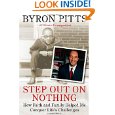
Recently read Byron Pitts’ Step Out on Nothinghis autobiography about making it to CBS’ 60 Minutes as a correspondent, from being unable to read and speak without a stammer, all through grade school.  The subtitle is How faith and family helped me conquer life’s challenges

His mother’s refusal to accept what others said disparagingly about her obviously gifted son; her Christian faith – expressed with intensity, complete with expletives; her no-holds-barred parenting style; and, his own faith, hard work, and courage have got to lift your spirits, no matter what you’re going through.  The best part was his giving the graduation speech, at the same university where his freshman English professor had told him he was wasting the government’s money on his scholarship, since he wasn’t college material.  The same professor was retiring, and got to hear the speech on his last day there.  Who said God doesn’t have a sense of humor? 

A must for everyone, but especially for kids with learning challenges and parents of children with issues.

If you’re time challenged, try it on audiobooks, while at the gym or travelling.